
Hey BC, Sign the Gender-Based Violence (GBV) Declaration
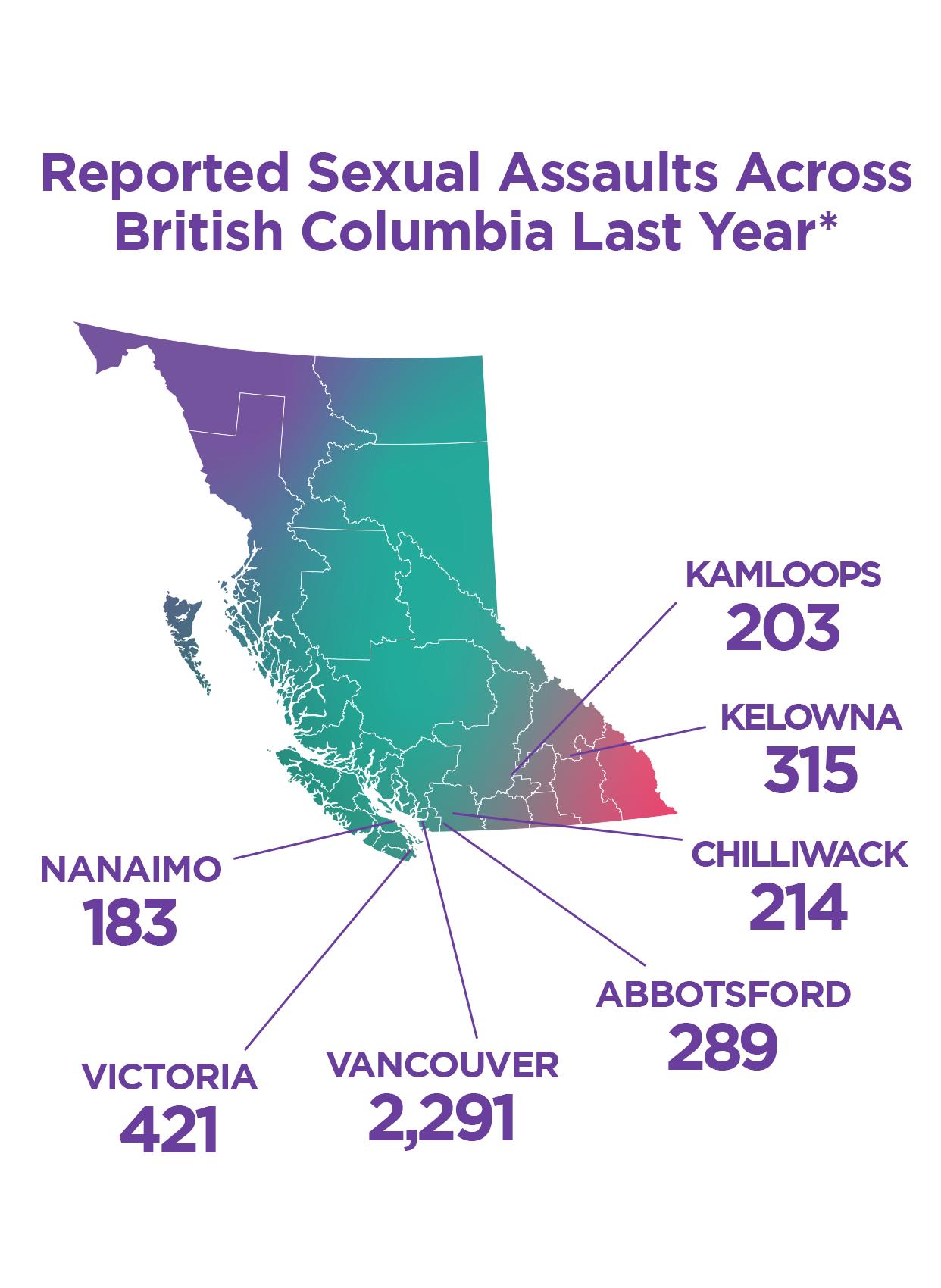
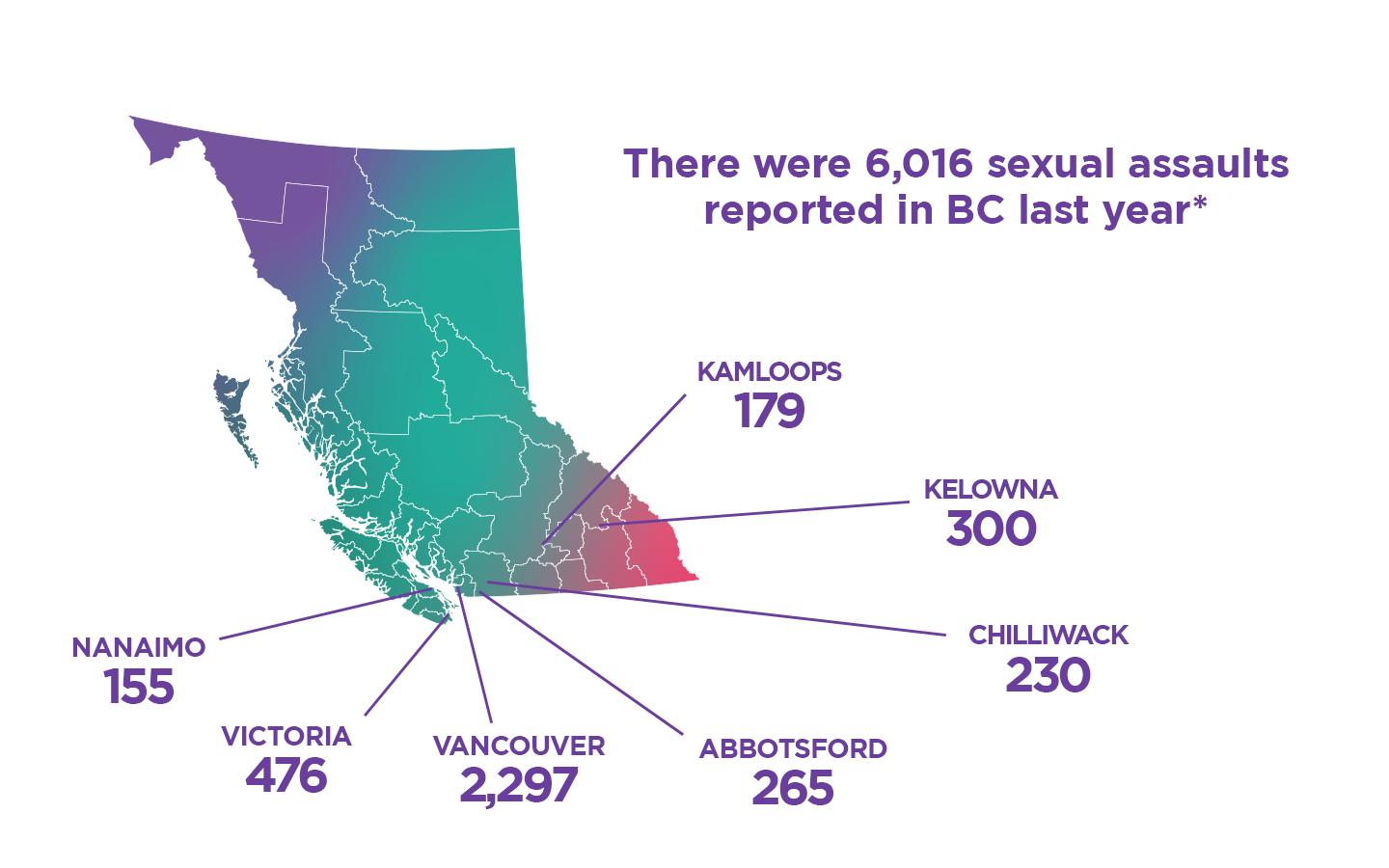
Statistics Canada. Table 35-10-0177-01; Incident-based crime statistics, by detailed violations, Canada, provinces, territories, Census Metropolitan Areas, and Canadian Forces Military Police.
Data from the listed violations in the year 2024 were tabulated to calculate the total incidents of sexual assaults, including: Sexual assault, level 3, aggravated [1310], Sexual assault, level 2, weapon or bodily harm [1320], Sexual assault, level 1 [1330], Sexual interference [1345]27, 28, Invitation to sexual touching [1350]27, 28, Sexual exploitation [1355]27, 28, Agreement or Arrangement - sexual offence against child [1371]29, Other sexual violations [1340], Sexual Exploitation of a person with a disability [1356], Non-consensual distribution of intimate images [1390]30, Sexual offences, public morals, and disorderly conduct (Part V Criminal Code) [3740].
The numbers only tell part of the story. Sexual assault is the most underreported crime in Canada, with just 6% of incidents reported to police1.
This gap reveals how much more gender-based violence exists in our communities than official data shows. It’s why we need to reduce stigma and push for systemic reforms to improve prevention, support and accountability.
1. Adam Cotter, Canadian Centre for Justice and Community Safety Statistics, Statistics Canada, 2019
As part of our Close to Home campaign, we're highlighting reported sexual assault data from Statistics Canada. But here’s the challenge: reliable, comprehensive data on gender-based violence is limited. This lack of information makes it harder to understand the full scope of the problem. That’s why one of our key calls to action is better data collection, including a regular coroner’s review of deaths linked to gender-based violence.
This draft declaration was sent to the BC government on Nov. 19. It has not been adopted or signed.
Declaration on Gender-Based Violence as a Provincial Epidemic and Systemic Crisis
Preamble
Gender-based violence is a pervasive and systemic crisis in British Columbia, threatening the equality, safety, dignity, and human rights of individuals and communities.
The term epidemic, as used in this Declaration, signifies a crisis of social and systemic proportions; one that is pervasive, preventable, and sustained by structural inequities. Gender-based violence reaches every community, generation, and sector, causing profound harm to individuals, families, and society as a whole. Its economic and social costs are staggering, encompassing health care, justice, and social services expenditures, lost productivity, and intergenerational trauma. Recognizing it as an epidemic and systemic crisis affirms both the scale of the crisis and our collective responsibility to act.
Gender-based violence includes physical, sexual, psychological, economic, and financial forms of harm, including intimate partner violence and coercive and controlling behaviours. The Government of Canada defines gender-based violence as violence committed against someone based on their gender, gender identity, gender expression, or perceived gender, occurring in private, public, and online settings and rooted in gender inequality, abuses of power, and harmful norms.
Gender-based violence constitutes a profound human rights violation, rooted in and perpetuated by intersecting systems of oppression, including patriarchy, colonialism, racism, sexism and other structural inequities that sustain discrimination and unequal power relations.
Gender-based violence affects people of all genders, yet disproportionately impacts women, girls, and gender-diverse people, as well as Indigenous women, girls, and Two-Spirit+ people and underpins the concurrent crisis of Missing and Murdered Indigenous Women, Girls and Two-Spirit+ peoples.
Noting with deep concern that the scale of this crisis is unacceptable: nearly half of all women (48%) in British Columbia have experienced some form of intimate partner violence since the age of 15, and 30% have experienced physical or sexual violence in particular; that more than one in three women (37%) have experienced sexual assault, constituting the highest rate among all provinces and territories in Canada; and that only a small proportion of survivors, approximately 5%, report these assaults to police and 9% seek victim services;1 and that 59% of transgender and gender-diverse people report experiencing violent victimization.2
Recognizing that these statistics capture only part of the problem, and that the impacts of gender-based violence are far-reaching; threatening individual and collective safety, health, and well-being, and undermining equality and justice.
Affirming that the widespread prevalence and systemic nature of gender-based violence constitutes an epidemic; one that extends across communities, affects multiple generations, and causes profound social, health, and economic harm, requiring a coordinated and sustained public response.
Acknowledging that women, girls, and gender-diverse people are integral to the social, cultural, and economic fabric of British Columbia, and that their leadership, resilience, and contributions strengthen our communities and are essential to building a more just and equitable province.
Recalling Recommendation 1 the final report of The British Columbia Legal System’s Treatment of Intimate Partner Violence and Sexual Violence by Dr. Kim Stanton, which recommends that the British Columbia government declare gender-based violence an epidemic.
Reinforcing the Union of B.C. Indian Chiefs’ Resolution 2025-52 dated October 8, 2025, which calls on the provincial and federal governments to formally declare gender-based violence an epidemic and systemic crisis, highlights its disproportionate impact on Indigenous women, girls, and 2SLGBTQQIA+ peoples, and urges a coordinated, whole-of-government response and increased public awareness.
Recognizing the Truth and Reconciliation Commission of Canada’s Calls to Action and the National Inquiry into Missing and Murdered Indigenous Women and Girls’ Calls for Justice, which clearly identified gender-based violence as a national crisis, and call on all levels of government to take urgent and sustained action.
Noting the Final Report of the Mass Casualty Commission found that “Gender-based, intimate partner and family violence is an epidemic”; and Recommendation V.14 which urges that “All levels of government in Canada declare gender-based, intimate partner, and family violence to be an epidemic that warrants a meaningful and sustained society-wide response”.
Recognizing therefore that gender-based violence is not a private matter but a public safety and public health crisis, a justice issue, an economic issue, and a violation of human rights. Its scale, severity, and persistence, together with its systemic roots, widespread prevalence, and intergenerational impacts demand that it be recognized and addressed as an epidemic requiring urgent coordinated, whole-of-government and whole-of-society response.
This Declaration acknowledges that in order for it to be meaningful and create systemic transformation, it must go beyond recognition and span across government to enact public education, decisive action and tangible policy and legislative implementation.
This Declaration signals the beginning of a coordinated government and community response, establishing concrete policies, programs, and funding to prevent gender-based violence, protect survivors, and address its profound social, economic, and intergenerational impacts across British Columbia.
Declaration
The Government of British Columbia declares that gender-based violence is an epidemic and systemic crisis in the province which requires urgent action.
We affirm that:
-
Every person has the right to safety, security, and dignity.
-
Every person has the right to live free from violence and coercion.
-
Gender-based violence constitutes a violation of equality and human rights, incompatible with a just and inclusive society.
The Government of British Columbia commits to:
-
Taking urgent, coordinated, and sustained action to end the full spectrum of gender-based violence.
-
Embedding a whole-of-government and whole-of-society approach that engages all ministries, sectors, communities, and Indigenous Nations through nation-to-nation engagement, while actively collaborating with women’s rights and Indigenous women’s organizations, survivors and families.
-
Centering survivors, families, and Indigenous and community voices in all prevention, response, system-building efforts, and decision-making processes.
-
Advancing person-centred intersectional, trauma-informed, and culturally safe approaches that strengthen prevention, healing, and accountability.
-
Upholding transparency, accountability, and ongoing public reporting to measure progress and maintain public trust.
-
Exploring avenues for stable, multi-year funding to support sustainable prevention, response, and survivor services.
-
Launch a province-wide gender-based violence prevention educational campaign to address underlying misogyny, racism, and discrimination which perpetuate the normalization of harmful attitudes, beliefs and behaviours of gender-based violence.
Commitment to Accountability
To ensure sustained action and accountability, the Government of British Columbia will:
-
Commit to implementing the recommendations outlined in Dr. Kim Stanton’s report, The British Columbia Legal System’s Treatment of Intimate Partner Violence and Sexual Violence. This includes establishing an independent Commissioner or Secretariat on gender-based violence to monitor progress, coordinate across ministries and municipalities, and report annually to the public and legislature, along with other systemic reforms to strengthen prevention, response, and accountability.
-
Ensure adequate and sustained resources to support implementation, including prevention, frontline services and culturally safe supports and systemic reforms.
-
Explore ways to integrate gender-based violence priorities into each ministry’s annual action or implementation plan, which may include resource allocation, programming, and policy and legislative measures, to support sustained and systemic attention.
This declaration represents a renewed and resolute commitment to ending gender-based violence in British Columbia. It affirms that the safety, dignity, and equality of women, girls, and gender-diverse people are non-negotiable, and that a coordinated, long-term, and intersectional approach is essential to promoting safety and achieving justice for all.
Annex: Recommendations for Implementation
This annex outlines recommended actions and priority areas to guide the implementation of the Declaration, and calls on the province to take action on the recommendations of Dr. Kim Stanton’s Independent Systemic Review: The British Columbia Legal System’s Treatment of Intimate Partner Violence and Sexual Violence. It provides a roadmap for coordinated, systemic action across government and society, ensuring that prevention, survivor support, and accountability measures are informed by evidence, best practices, and the systemic reforms identified in the report.
A. Governance and Accountability
-
Establish an Independent Office or Commissioner on Gender-Based Violence to coordinate action across levels of government, ministries, and sectors, to monitor implementation, and report annually to the legislature and the public.
-
Where independence is not feasible immediately, create an Inter-ministerial Secretariat with cross-government mandates, clear accountability, and annual progress reports.
-
Require annual reporting similar to the Declaration on the Rights of Indigenous Peoples Act and other legislative mechanisms (e.g., the Declaration Act reporting framework).
-
Build on existing commissions and inquiries rather than duplicating efforts.
B. Prevention and Education
-
Launch a comprehensive public education campaign to address the normalization of harmful attitudes, beliefs and behaviours which underlie gender-based violence and which have culminated in a public safety and human rights issues and the Missing and Murdered Indigenous Women, Girls, Two-Spirit+, and gender-diverse people (MMIWG2S+) crisis.
-
Work with survivors, families, women’s organizations, experts and Indigenous Peoples to expand province-wide age-appropriate gender-based violence and MMIWG2S+ education across K–12 and post-secondary curricula.
-
Ensure sustainable multi-year funding for community-based prevention programs, particularly those led by Indigenous, racialized, and gender-diverse organizations.
C. Support for Survivors and Families
-
Expand access to safe and affordable housing for survivors.
-
Strengthen income security and access to justice mechanisms.
-
Increase culturally safe and trauma-informed health, legal, and social supports.
-
Strengthen children and family support systems in gender-based violence prevention and response.
-
Ensure families and survivors are consulted and fully involved at decision-making tables pertaining to gender-based violence prevention and the MMIWG2S+ crisis.
D. Policy Integration and Cross-Ministry Action
-
Ensure that a rights-based, gender-based analysis plus, trauma-informed and culturally safe approach and considerations are integrated across all provincial ministries and policy areas. This cross-government approach recognizes that gender-based violence intersects with multiple sectors and requires coordinated, structural action beyond the justice and health systems.
-
Leverage budgetary planning cycles to align resources with long-term gender-based violence prevention.
E. Long-Term Vision
-
Develop a roadmap grounded in human rights and reconciliation.
-
Set measurable indicators for prevention, support, and accountability.
-
Ensure ongoing consultation with survivors, families, Indigenous Nations, and civil society.
-
Maintain the aspirational and transformative vision of the declaration while prioritizing the advancement of concrete, actionable and practical steps including policy and legislative changes.
F. Implementation and Review
-
Within 12 months of this Declaration, the province will update and strengthen Safe and Supported: British Columbia’s Gender-Based Violence Action Plan to include clearer targets, timelines, and ministerial responsibilities, ensuring alignment with the commitments and priorities set out in this Declaration.
-
Track progress through key indicators and data, update the Action Plan regularly to reflect emerging needs and best practices, and publicly report results to ensure transparency and accountability.
-
Conduct a comprehensive review every five years to assess progress, update strategies, and strengthen systemic prevention, response, and accountability measures.
[1] https://ywcavan.org/gender-based-violence-gbv-happens-everywhere-bc
[2] Government of British Columbia , https://www2.gov.bc.ca/gov/content/justice/about-bcs-justice-system/justice-reform-initiatives/systemic-review
November 19, 2025
The Honourable David Eby, MLA
Premier of British Columbia
The Honourable Brenda Bailey, MLA
Minister of Finance
The Honourable Niki Sharma, MLA
Attorney General
The Honourable Nina Krieger, MLA
Minister of Public Safety and Solicitor General
Jennifer Blatherwick, MLA
Parliamentary Secretary for Gender Equity
Dear Premier Eby, Minister Bailey, Attorney General Sharma, Minister Krieger, and Parliamentary Secretary Blatherwick:
On behalf of YWCA Metro Vancouver and our coalition of more than 40 organizations and advocates across British Columbia, we are writing to request your urgent review and endorsement of the attached Declaration on Gender-Based Violence as a Provincial Epidemic and Systemic Crisis.
Recent findings from Dr. Kim Stanton’s independent systemic review, commissioned by the Attorney General, reveal the alarming prevalence of gender-based violence (GBV) in our province. The report highlights that 80% of intimate partner violence and 94% of sexual assaults go unreported and nearly early half of BC women over the age of 15 have experienced intimate partner violence. As Dr. Stanton notes, these statistics should be shocking, but they have been normalized. These figures underscore not only the scale of the crisis but also the need for immediate, coordinated action.
In light of these findings, we urge the province to declare gender-based violence a provincial epidemic and systemic crisis. This declaration aligns with Dr. Stanton’s recommendations and sends an authoritative signal that the province is committed to ending GBV through prevention, support for survivors and systemic change.
During the upcoming 16 Days of Activism Against Gender-Based Violence, we will be launching a public engagement campaign to galvanize awareness and public support for the declaration. Your timely endorsement would demonstrate provincial leadership, strengthen public trust and catalyze collective accountability.
Decades of fragmented approaches have failed to meaningfully reduce GBV, a reflection of entrenched systemic barriers such as siloed services, insufficient accountability and persistent structural inequalities. A formal declaration would be more than symbolic; it is a vital step toward building a coordinated, well-resourced, and transformative response.
We respectfully call on your leadership to make this declaration a reality. Enclosed is a draft of the declaration, which outlines the actions and framework we seek your support in adopting provincially.
Thank you for your consideration. We welcome the opportunity to meet and discuss how we can support the province in advancing these bold and necessary commitments.
Sincerely,
Erin Seeley
CEO, YWCA Metro Vancouver