
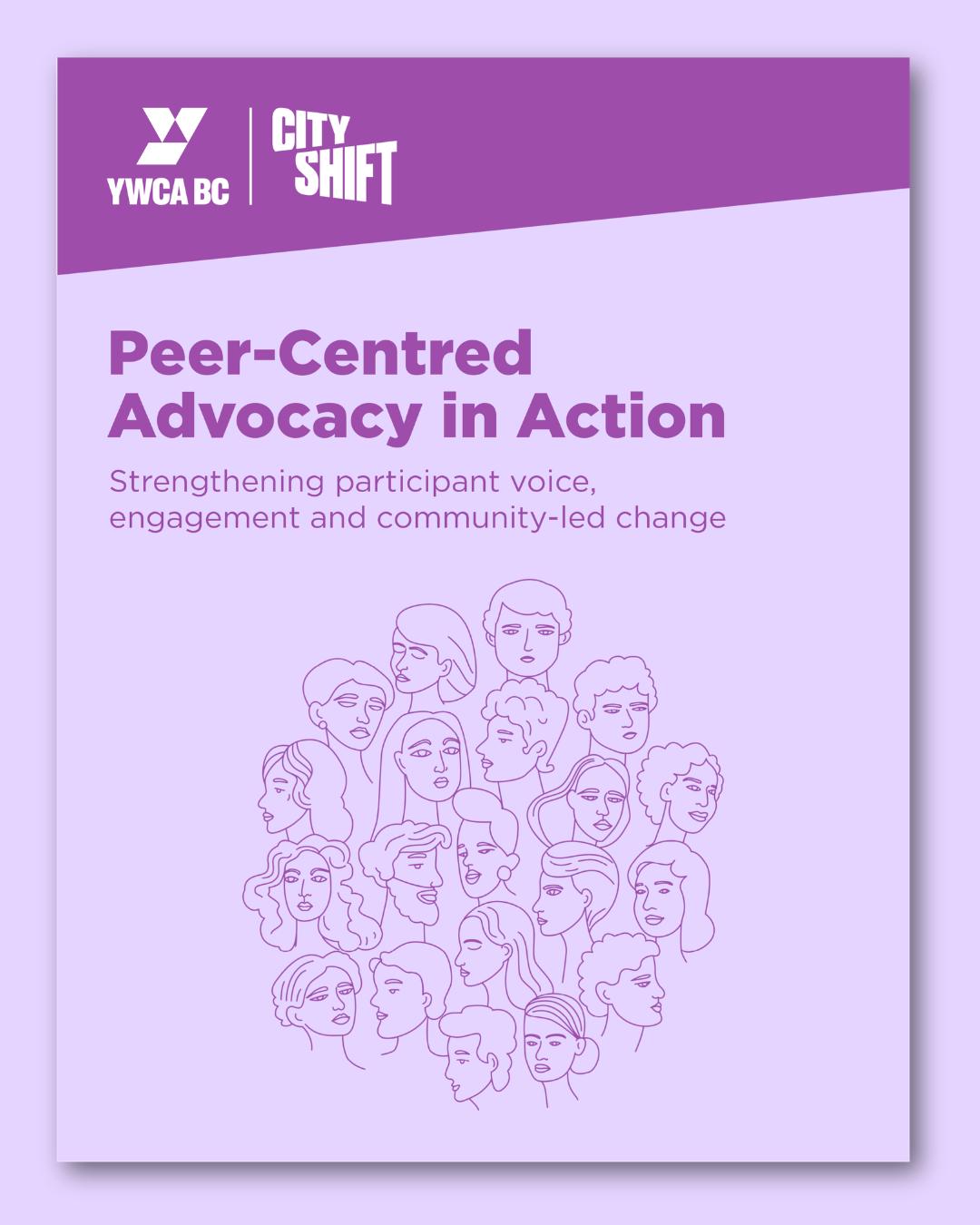
Guidebook: Peer-Centred Advocacy in Action
Peer-Centred Advocacy in Action:
Strengthening participant voice, engagement and community-led change
Download the guide
Peer-centred advocacy builds collective power and equips community leaders to drive tactical and systemic change.
YWCA City Shift’s Peer-Centred Advocacy Council was created for that purpose. The pilot cohort, alumni of YWCA Single Mothers’ Support Services, gained practical advocacy tools while offering insight into how YWCA BC can more meaningfully engage participants across the organization’s advocacy efforts.
Beyond skills, this council developed practices that strengthen participant-centred work. These insights shaped this guidebook and continue to inform how the YWCA engages, listens and collaborates with participants in meaningful and impactful ways.
YWCA BC has long championed the rights, safety and well-being of women, gender-diverse people and families across the province.
Our advocacy is grounded in what we see every day in our programs: women navigating impossible choices between housing and food, single parents balancing work and care without support, survivors of violence trying to heal and rebuild stability, and communities facing intersecting barriers that limit their ability to thrive.
Across all of this work, one truth is constant: advocacy is most powerful, credible and transformative when it is grounded in the real experiences of the people most affected by the issues.
This guidebook shows what becomes possible when those voices are not only consulted, but resourced and empowered to lead.
Advocacy designed with communities, not for them
We convened a cohort of women parenting alone to explore systemic change shaped by people who experience precarious housing, gender-based violence, unaffordable child care, employment instability and the ongoing impacts of gender inequality. Shared experiences built trust; diversity of culture, age, identity, circumstance and perspective made the process more nuanced and reflective of the communities we serve.
The result is a model for advocacy by single mothers and for single mothers; one that treats lived experience as expertise and positions participants as leaders, strategists and co-creators of solutions.
Building a sustainable peer-centred advocacy model
This pilot was made possible through the support of Women and Gender Equality Canada. It represents the beginning of a longer-term shift in how YWCA BC engages the people we serve in shaping the systems that shape their lives.
As we move forward, we will:
- Continue hosting participant engagement sessions to inform our advocacy.
- Create pathways for participants to co-design solutions, lead conversations and influence public policy.
- Explore opportunities to scale peer advocacy practices across other YWCA programs.
This guidebook supports anyone seeking to deepen participant engagement, whether through a peer-centred advocacy council or by integrating participant-centred practices into current programs and advocacy efforts.
It introduces the core principles, shares key learnings from the pilot and offers adaptable approaches that can be applied across a range of contexts.
Use this guide to:
- Understand the model: Learn what a peer-centred advocacy council is and how participants’ insight strengthens advocacy.
- Inform your planning: Explore examples of timelines, recruitment strategies, team roles and session structures that can support the development of your council.
- Customise your approach: Adapt the sample processes, schedules and budget considerations to fit the capacity, goals and realities of your team or community.
- Support meaningful participation: Use tips and lessons learned to create an environment where participants feel better prepared, supported and able to contribute meaningfully.
Visit the City Shift page for more information about YWCA BC and YWCA City Shift.
City Shift is funded by Women and Gender Equality Canada
